
Dear Reader,
If life is a tree, then choices are leaves. Some get plucked (circumstances), some fall with the seasons, and a few stay, shaping the tree’s story.
When I watched Homebound, the Hindi movie that missed its run at the Oscars, I wasn’t just struck by the theme of an unequal and unfair world but also by the familiar cycle of aspirations and choices that plays out differently depending on one’s position in the social hierarchy.
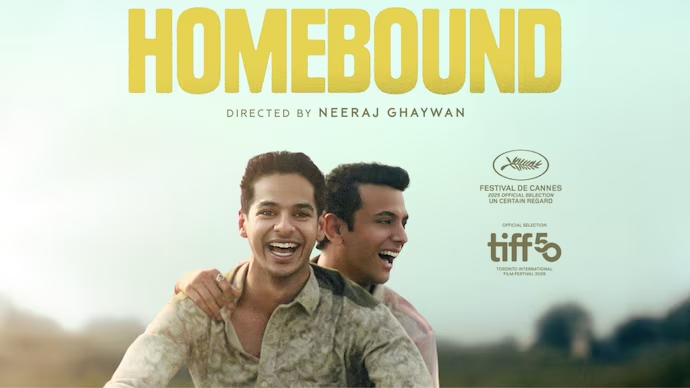
(Image courtesy: India Today)
The template is common — work hard, do it right, and trust the process. So, you do it and keep on doing it until the bottlenecks begin to show — often masquerading as destiny — competition, corruption, contact and a fractured system.
The protagonist’s journey in the movie resonates deeply. You begin to wonder if you missed your chance long ago, made the wrong choices and the hurt lingers. Then, of course, the gatekeepers appear, offering alternatives and subtle hints of dismissal that chip away at your grit — the only door that probably remains open after all others close.
Over time, the lack of rewards leads to a façade of contentment and you are high on mediocrity but a sort of resentment fills your innards. There’s no way to understand where one has gone wrong? Or, may be, an illusion of that understanding exists. The trap is so real that you gently push another generation into it promising to better things with your experience.
The disillusionment in Homebound gets to you not just because it reflects the larger narrative of class, caste, and privilege (which I’m not touching upon today) but also because it challenges narratives of positivity and hope in the face of failure, reminding us that hope itself can be a privilege. It highlights the complexity of aspirations and the harsh realities of choices that shape them. Privileges don’t guarantee success and the system is rigged but what choice do we really have? Sometimes none. Could choosing lack of aspirations lead to greater emotional stability? (Because while the struggle for success [iceberg analogy for example] is acknowledged, nobody talks about the cost of failure – time, effort, stress, loss of confidence). Who knows! Those are irreversible choices and we can’t understand the gains or losses until we’ve walked the path.
Wondering about the paradox of choice, I am reminded of this famous passage about a fig tree in The Bell Jar by Sylvia Plath. Reading it for you. (I couldn’t get an image of a fig tree, so just another one from my camera).
Inspired by the passage is an attempt at a poem about choices.

Drifting on the River
waters whisper to me
secrets of choices made/unmade.
A gentle current tugs at my raft,
reminds me of forgotten dreams.
Each bend is a story, a fork in the flow;
fragments of decisions past float by
like leaves on languid loops.
The river’s voice echoes
what-ifs/almosts. Its depths carry
the reflections of choices. And I know,
I’ll choose again—
the river will run its course.
January Nightstand Reading
January was mostly about short stories. I read two collections — Subi Taba’s Tales from the Dawn-lit Mountains and The Bare Bones Book of Humour. Find out more about them in this post on Instagram.
Here’s a reading of my poem ‘Kyu Dambh Hun Main’ that was published in Pratigyan Prakashan’s beautiful collection ‘Main – Suksham, Pyasa, Mukhauta’. If you are an admirer of Hindi poetry, you will definitely find this collection that traces a journey from without to within through poems that cut deep. Here’s the purchase link for you.
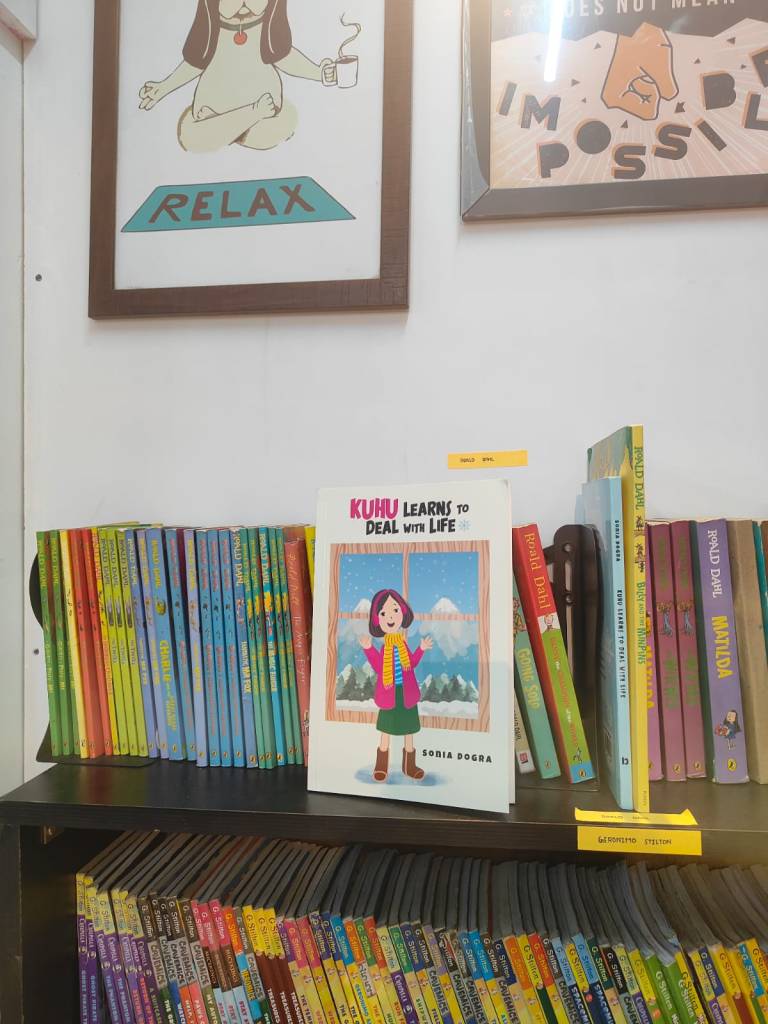
Before I close, here’s a picture of Kuhu Learns to Deal With Life at the Read and Brew Library, Pune, sent to me by dear friend and writer Rashmi Agrawal. Thank you for all the kindness in my life.
Until we meet again, stay safe and happy and do tell me how choices have played out in your life.
Discover more from A Hundred Quills
Subscribe to get the latest posts sent to your email.
 A Hundred Quills
hey Sonia,
thank you for reading that passage and reminding me of the fig tree.
the fig tree and me have been friends for too long. So long that the disappointment of the figs decaying and falling down before i pluck the right one, doesn’t even bother me anymore.
I think at some point you befriend mediocrity as survival technique. You find happiness while going nowhere.
i think having a choice is a privilege and a curse.
loved the metaphor of the river in your poem, the fallen leaves floating past, and the end is where you continue to see your reflection!
LikeLiked by 1 person
Hope is a privilege – that’s such as apt observation.
I need to finish watching Homebound. i watched it halfway, then took a break because the heaviness unsettled me.
LikeLiked by 1 person
Now, I’ve got to watch it too! 🙂
LikeLike
I must see this much talked about movie . I think essentially in life what matters most is luck. You can bang your head , climb mountains and kill yourself getting there but nothing will move unless it was meant to. I am not advocating inaction but merely reiterating the fact that action does not always equal fruition .
LikeLike
“Homebound” sounds like a first-rate movie that I would enjoy. It’s at times like these that I really regret being monolingual.
You read Plath’s heartbreaking poem beautifully. I was very moved.
LikeLiked by 1 person
Thank you, Liz. It has subtitles though and is available on Netflix if you’d like to consider.
LikeLiked by 1 person
You’re welcome, Sonia. Thank you for letting me know about the subtitles.
LikeLiked by 1 person
Loved the review and poem. The Paradox of Choice indeed❤️
LikeLiked by 1 person
Thank you, Madhuri. Yes, the paradox of choice.
LikeLike
Love the reading and the point about being high on mediocrity…. !!!
LikeLiked by 1 person
Thank you, Rajani!
LikeLiked by 1 person
Loved the poem, Sonia ji! Thank you for mentioning ‘Pratigyan’.
LikeLiked by 1 person
Thank you so much!
LikeLiked by 1 person
This reminds me of Robert frost ” the road not taken”. Your choices determine your life. Who knows what would have happened had you taken the other one.
LikeLiked by 1 person
Yes, that one is a classic example of this paradox. Thank you, Ruchi.
LikeLike